


 English
 Afrikaans
 Albanian
 Amharic
 Arabic
 Armenian
 Azerbaijani
 Basque
 Belarusian
 Bengali
 Bosnian
 Bulgarian
 Catalan
 Cebuano
 Chichewa
 Chinese (Simplified)
 Chinese (Traditional)
 Corsican
 Croatian
 Czech
Czech Danish
 Dutch
Dutch Esperanto
 Estonian
 Filipino
 Finnish
 French
 Frisian
 Galician
 Georgian
 German
 Greek
Greek Gujarati
 Haitian Creole
 Hausa
Hausa Hawaiian
 Hebrew
 Hindi
Hindi Hmong
Hmong Hungarian
 Icelandic
 Igbo
Igbo Indonesian
 Irish
Irish Italian
 Japanese
 Javanese
 Kannada
 Kazakh
 Khmer
Khmer Korean
 Kurdish (Kurmanji)
 Kyrgyz
 Lao
Lao Latin
Latin Latvian
 Lithuanian
 Luxembourgish
 Macedonian
 Malagasy
 Malay
Malay Malayalam
 Maltese
 Maori
Maori Marathi
 Mongolian
 Myanmar (Burmese)
 Nepali
 Norwegian
 Pashto
 Persian
 Polish
 Portuguese
 Punjabi
 Romanian
 Russian
 Samoan
 Scottish Gaelic
 Serbian
 Sesotho
 Shona
Shona Sindhi
 Sinhala
 Slovak
 Slovenian
 Somali
 Spanish
 Sudanese
 Swahili
 Swedish
 Tajik
Tajik Tamil
Tamil Telugu
 Thai
Thai Turkish
 Ukrainian
 Urdu
Urdu Uzbek
Uzbek Vietnamese
 Welsh
Welsh Xhosa
Xhosa Yiddish
 Yoruba
 Zulu
Zulu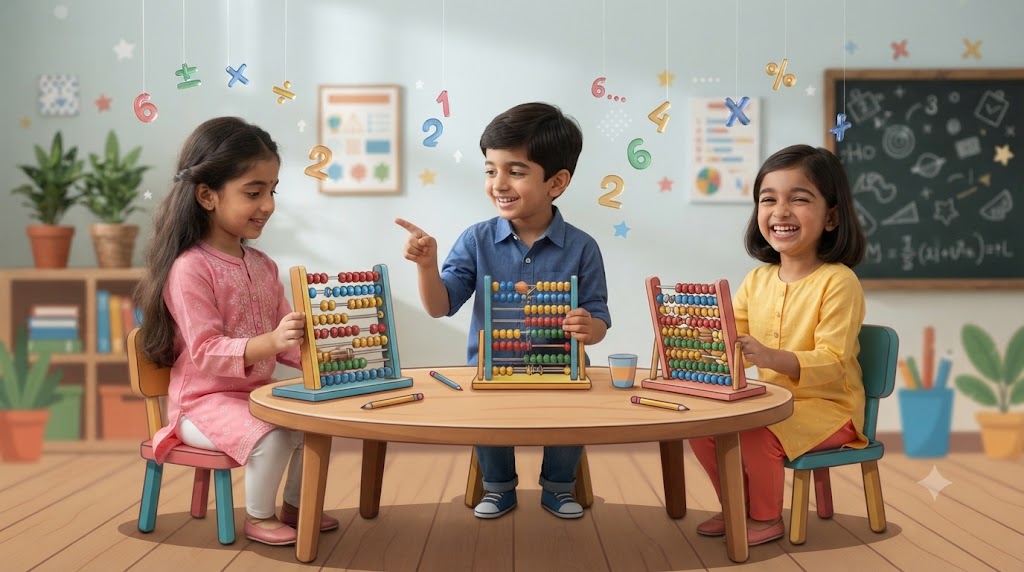
ABACUS Course for Children — Age 4 to 12 Years
Abacus Course for Children Aged 4 to 12 Years: Complete Syllabus, Levels, Duration & Parent Guide
Introduction

Abacus training is one of the most effective ways to build a child’s foundation in mathematics, concentration, and mental calculation. Designed for children between 4 and 12 years old, abacus courses transform the ancient calculating tool into a powerful brain-development programme that helps children calculate faster than a calculator—first using the physical abacus, and eventually using only their mind.
This guide covers everything parents need to know: the full curriculum, number of levels, detailed level-by-level breakdown, target age groups, course duration, and how to choose the right programme for your child.
What Is an Abacus Course?
An abacus course teaches children to perform arithmetic operations using a physical abacus, then gradually trains them to visualise the beads in their mind. This technique is called Abacus-Based Mental Calculation (AMC) . Over time, children develop the ability to solve complex addition, subtraction, multiplication, and division problems without any physical tool.
Research has shown that AMC learning is linked to arithmetic advantages, improved numerical processing skills, better short-term memory, and enhanced attention—especially with longer training experience. A five-year scientific study found that abacus training can fundamentally reshape how children’s brains work, fostering coordinated development of critical cognitive abilities.
Course Syllabus and Curriculum Overview
While specific programmes vary, most abacus courses follow a structured, progressive curriculum that builds from basic bead manipulation to advanced mental arithmetic. The core syllabus typically includes:
Foundation Topics
-
Number Bonding: Understanding how numbers combine and break apart
-
Place Value: Ones, Tens, Hundreds
-
Basic Bead Movement: Reading and manipulating the abacus
-
Finger Techniques: Using both hands for coordinated movement
-
Single-Digit Addition and Subtraction on the abacus
Intermediate Topics
-
2-Digit and 3-Digit Addition and Subtraction on the abacus
-
Visualisation in Brain: Picturing single and double-digit numbers mentally
-
Multiplication: 2-digit × 1-digit, 3-digit × 1-digit
-
Long Sums: Multi-number addition and subtraction
-
Mental Calculation without the physical abacus
Advanced Topics
-
Multiplication: 2-digit × 2-digit, 3-digit × 2-digit, 3-digit × 3-digit
-
Division: 3-digit ÷ 1-digit, 4-digit ÷ 1-digit
-
Decimal Operations: Addition, subtraction, multiplication, and division of decimals
-
Square Roots and Cube Roots
-
Complex Linear Equations
-
Competition Preparation: Math Olympiads and abacus competitions
The curriculum also emphasises mental arithmetic using visual, auditory, and sensory inputs, which strengthens the coordination between the left and right sides of the brain.
Number of Levels in Each Course
The number of levels varies by programme provider. Here is a comparison of common structures:
| Programme | Number of Levels | Structure |
|---|---|---|
| Sharp Abacus | 8 Levels | Yellow Belt to Black Belt |
| Kids Infinite Learning | 8 Levels | Basic to Advanced |
| UCMAS | 10 Levels | Basic (Level 1) to Grand (Level 10) |
| SIP Abacus | 11 Levels | 4 Foundation + 4 Advanced + 3 Grand Master |
| General Programmes | 8–11 Levels | Varies by provider |
Most programmes require all students to start from Level 1 and progress sequentially, mastering each stage before advancing.
1. Course Objective
The program is designed to develop:
- Number sense and basic mathematical understanding
- Addition, subtraction, multiplication and division
- Mental calculation and visualization
- Speed and accuracy
- Concentration and listening skills
- Memory and observation
- Logical thinking and problem-solving
- Confidence in handling mathematics
The curriculum gradually moves children from physical Abacus calculation to mental visualization and mental arithmetic.
2. Target Age Group
| Age | Recommended Stage | Focus |
|---|---|---|
| 4–5 years | Foundation / Pre-Abacus | Numbers, counting, Abacus introduction |
| 5–7 years | Beginner | Basic addition & subtraction |
| 7–9 years | Elementary | Formulas, visualization, larger calculations |
| 9–10 years | Intermediate | Multiplication, division & mental calculation |
| 10–12 years | Advanced | Complex calculations, speed & accuracy |
Programs in India commonly divide children into age-specific tracks because younger children require more foundational and activity-based learning.
Detailed Information About Each Level
Below is a level-by-level breakdown based on a typical 8-level progression, which is the most common structure:
Level 1 (Yellow Belt / Foundation)
Duration: 2–3 months
Skills Developed:
-
Introduction to the abacus
-
Basic bead movement
-
Number recognition (1–99)
-
Single-digit addition and subtraction
-
Finger techniques
-
Understanding place value (Ones, Tens, Hundreds)
Level 2
Duration: 3 months (approximately 13 classes)
Skills Developed:
-
2-digit and 3-digit addition and subtraction on the abacus
-
Visualising 2-digit and 1-digit numbers in the brain
-
Introduction to mental abacus for simple calculations
Level 3
Duration: 3 months (approximately 13 classes)
Skills Developed:
-
Multiplication: 2-digit × 1-digit, 3-digit × 1-digit
-
Long sums: 2-digit and 3-digit addition and subtraction
-
Visualising 2-digit and 3-digit numbers in the brain
-
Continued mental calculation practice
Level 4
Duration: 3 months (approximately 13 classes)
Skills Developed:
-
Multiplication: 2-digit × 2-digit, 3-digit × 2-digit, 3-digit × 3-digit
-
Addition and subtraction: 3-digit and 4-digit numbers
-
Visualising multiplication in the brain
-
Advanced mental addition and subtraction
Level 5
Duration: 3 months
Skills Developed:
-
Introduction to division: 3-digit ÷ 1-digit
-
Division: 4-digit ÷ 1-digit
-
Decimal addition and subtraction
-
Continued mental visualisation with larger numbers
Level 6
Duration: 3 months
Skills Developed:
-
Advanced division techniques
-
Multiplication of larger numbers
-
Mental calculation of complex problems
-
Introduction to decimal multiplication and division
Level 7
Duration: 3 months
Skills Developed:
-
Advanced mental math techniques
-
Square roots and cube roots
-
Complex linear equations
-
Preparation for certification exams
Level 8 (Black Belt / Advanced)
Duration: 3 months
Skills Developed:
-
Full mental calculation proficiency
-
Application in competitive exams and Math Olympiads
-
Ability to solve complex decimal multiplication and division
-
Speed and accuracy in all operations
Note: Programmes with 10 or 11 levels extend this structure with additional Grand Master levels that focus on advanced applications in school academics, competitive exams, and higher studies.
Target Age Group
The target age group for abacus courses is 4 to 14 years, with most programmes focusing on 4 to 12 years. However, specific programmes have different entry points:
| Programme | Target Age | Notes |
|---|---|---|
| SIP Abacus Junior | 6–8 years | Children in Class 1 or Class 2 |
| SIP Abacus Main | 8–12 years | Classes 3 to 7 |
| Sharp Abacus | 4–14 years | All levels |
| OnePA 3G Abacus | 4–12 years | Foundation programme |
| Little Inventors | 6+ years | Ideal for beginners |
The strongest age window for starting abacus is roughly 5 to 11 years, as this is when children’s cognitive abilities are most receptive to visual-spatial learning strategies. For very young children (4–5 years), offline classes with hands-on correction are often recommended, while children aged 7 and above can benefit equally from online or offline formats.
Course Duration
The total duration of a complete abacus course varies by programme:
| Programme | Total Duration | Per Level Duration |
|---|---|---|
| General (8 levels) | 24 months | 3 months per level |
| SIP Abacus | 13–16 weeks per level | 11 levels total |
| UCMAS | 30 months | 3 months per level |
| Basic & Intermediate | 1.5 years | Book A: 7–8 months, Book B: 7–8 months |
Class Frequency and Session Length
-
Sessions per week: Typically 1 session per week
-
Session duration: 2 hours to 2 hours 15 minutes for most programmes
-
Junior programmes: Some junior modules may have shorter sessions
-
Class size: Maximum 10 to 15 students per class for optimal attention
Key Benefits of Abacus Training
Cognitive Development
-
Enhanced concentration and attention span
-
Improved short-term and visuospatial working memory
-
Balanced development of left and right brain
-
Faster mental processing speed
Academic Performance
-
Improved school mathematics performance
-
Positive attitude towards math
-
Confidence in numerical problem-solving
Competitive Edge
-
Preparation for Math Olympiads and national/international abacus competitions
-
Ability to calculate faster than a calculator
-
Expertise in complex calculations
How to Choose the Right Abacus Course for Your Child
When selecting an abacus programme, consider these factors:
-
Teacher Certification and Experience: Verify that instructors are properly certified and have experience with young learners
-
Batch Size: Smaller batches (4–8 students ideal, maximum 10–15) ensure personalised attention
-
Online vs Offline:
-
Offline works better for very young children (5–6 years) or those needing hands-on correction
-
Online is equally effective for ages 7+ and offers flexibility and lower cost
-
-
Trial Period: Start with a 1-month trial at 2–3 different places before committing
-
Practice Requirements: Consistent daily home practice of 10–15 minutes between sessions is essential for progress
-
Programme Structure: Choose a programme with a clear level progression and certification pathway
Frequently Asked Questions
Q: At what age should my child start abacus?
A: The ideal age is 5 to 7 years, though some programmes accept children as young as 4. The strongest learning window is 5 to 11 years.
Q: How long does it take to complete the full abacus course?
A: Typically 1.5 to 2.5 years, depending on the programme and the child’s pace.
Q: Can abacus training help with school math?
A: Yes. Abacus training improves number sense, calculation speed, and confidence, all of which directly benefit school mathematics.
Q: Is online abacus training effective?
A: Yes, for children aged 7 and above, online training is equally effective when conducted live with small batch sizes and proper teacher interaction.
Q: How many levels are there in a typical abacus course?
A: Most programmes have 8 to 11 levels, with each level lasting approximately 3 months.
Conclusion
An abacus course for children aged 4 to 12 years is far more than a math class—it is a brain development programme that builds concentration, memory, speed, and confidence. With a structured curriculum spanning 8 to 11 levels, each lasting around 3 months, children progress from basic bead movement to complex mental calculation, eventually solving problems faster than a calculator.
Whether you choose an 8-level programme like Sharp Abacus, a 10-level UCMAS course, or the 11-level SIP Abacus structure, the key is to start early, practise consistently, and choose a programme with certified teachers and small batch sizes. The benefits extend far beyond mathematics—they shape how your child thinks, learns, and approaches challenges for years to come.
