


 English
 Afrikaans
 Albanian
 Amharic
 Arabic
 Armenian
 Azerbaijani
 Basque
 Belarusian
 Bengali
 Bosnian
 Bulgarian
 Catalan
 Cebuano
 Chichewa
 Chinese (Simplified)
 Chinese (Traditional)
 Corsican
 Croatian
 Czech
 Danish
 Dutch
 Esperanto
 Estonian
 Filipino
 Finnish
 French
 Frisian
 Galician
 Georgian
 German
 Greek
 Gujarati
 Haitian Creole
 Hausa
 Hawaiian
 Hebrew
 Hindi
 Hmong
 Hungarian
 Icelandic
 Igbo
 Indonesian
 Irish
 Italian
 Japanese
 Javanese
 Kannada
 Kazakh
 Khmer
 Korean
 Kurdish (Kurmanji)
 Kyrgyz
 Lao
 Latin
 Latvian
 Lithuanian
 Luxembourgish
 Macedonian
 Malagasy
 Malay
 Malayalam
 Maltese
 Maori
 Marathi
 Mongolian
 Myanmar (Burmese)
 Nepali
 Norwegian
 Pashto
 Persian
 Polish
 Portuguese
 Punjabi
 Romanian
 Russian
 Samoan
 Scottish Gaelic
 Serbian
 Sesotho
 Shona
 Sindhi
 Sinhala
 Slovak
 Slovenian
 Somali
 Spanish
 Sudanese
 Swahili
 Swedish
 Tajik
 Tamil
 Telugu
 Thai
 Turkish
 Ukrainian
 Urdu
 Uzbek
 Vietnamese
 Welsh
 Xhosa
 Yiddish
 Yoruba
 Zulu
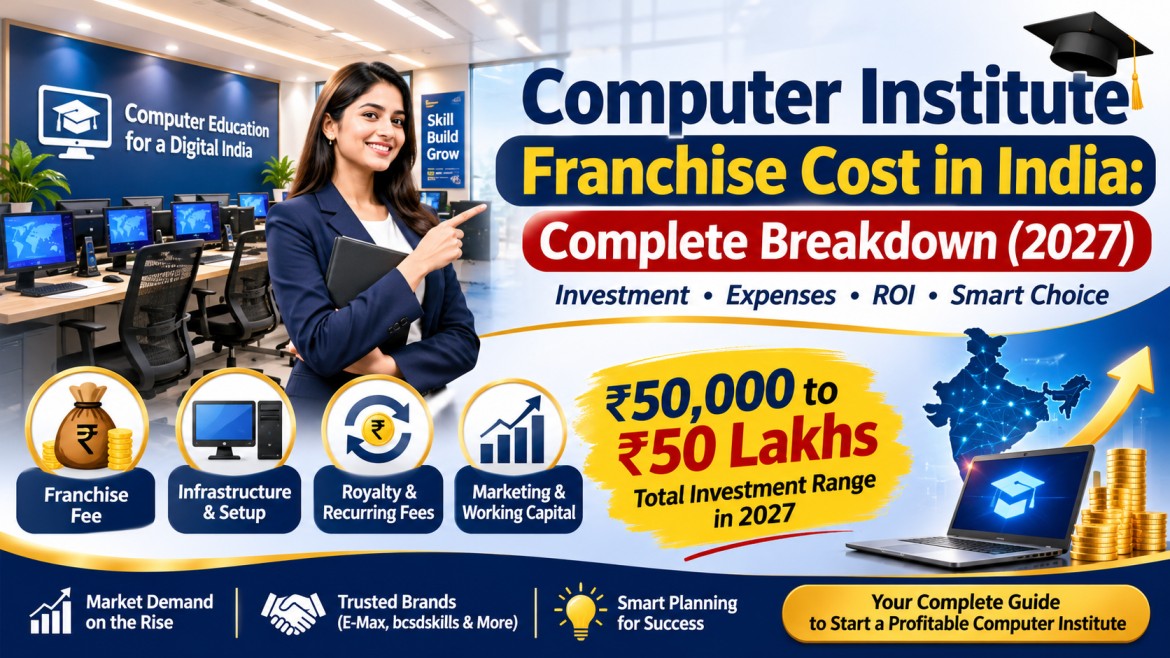
Computer Institute Franchise Cost in India: Complete Breakdown (2027)
Thinking about opening a computer institute in India? You’re looking at a market where demand for digital skills isn’t just growing—it’s exploding. But before you get swept up in the excitement of being your own boss, there’s one question that needs a brutally honest answer: How much does it actually cost?
The truth is, the “franchise fee” you see on a brochure is rarely the full story. In 2027, the total investment to get a computer institute off the ground can range from a lean ₹50,000 to a hefty ₹50 Lakhs, depending on the brand and model you choose. This guide breaks down the real numbers—not just the marketing gloss—so you can plan your budget with confidence.

The Quick Answer: Franchise Cost Ranges at a Glance
Before we dive deep, here’s a snapshot of what different franchise models look like across India in 2027. The range is massive because the business models are fundamentally different.
| Franchise Model | Estimated Total Investment | Typical Franchise Fee | Best For |
|---|---|---|---|
| Low-Cost / Zero-Fee Models | ₹10,000 – ₹50,000 | ₹0 – ₹50,000 | First-time entrepreneurs testing the waters |
| Mid-Tier Regional Brands | ₹2 Lakh – ₹10 Lakh | ₹1 Lakh – ₹3 Lakh | Balanced support and local flexibility |
| Premium District Hubs | ₹10 Lakh – ₹15 Lakh | ₹10 Lakh | Multi-revenue business hubs |
| National Legacy Brands (E-Max , bcsdskills) | ₹20 Lakh – ₹50 Lakh | ₹5 Lakh – ₹15 Lakh | High brand recall and structured systems |
The Real Cost Breakdown: Where Your Money Actually Goes
A computer institute franchise isn’t just a fee you pay and forget. It’s a sum of several moving parts. Here’s how the money breaks down across the four main categories.
1. The Franchise Fee (The “Brand Entry” Ticket)
This is the one-time fee you pay to use the brand’s name, curriculum, and systems.
-
Low-cost models: Some academies, pushing a 0 franchise fee model in 2007 to attract partners, instead charging a small per-student registration.
-
Mid-tier brands: Expect to pay between ₹1 Lakh and ₹3 Lakh. IT Skills Solutions lists a franchise fee of ₹3,00,000 plus GST.
-
Legacy giants: E-Max operate in a different league. E-Max franchise fee typically ranges from ₹2650/- to ₹14990/-.
2. Infrastructure & Setup Costs (The Biggest Variable)
This is where budgets truly explode or stay lean. You need a physical space, computers, and furniture.
-
Space: A lean centre might need just 200–300 sq. ft. with a total investment of ₹10,000–₹50,000). A premium brand may require 2,001–5,000 sq. ft..
-
Computer Lab: This is a non-negotiable capital expense. A basic lab with 10–15 systems, networking, and furniture can easily cost ₹2 Lakh to ₹5 Lakh, depending on the city and specifications. For a brand setup cost components include IT labs, student furniture, and software licenses within a total investment of ₹3–5 Lakh.
-
Interior & Branding: You’ll need to match the franchisor’s look and feel. This includes signage, paint, reception area, and classroom setup. Budget at least ₹1 Lakh to ₹3 Lakh for a mid-sized centre.
3. Royalty & Recurring Fees (The Long-Term Cost)
This is a critical number many new franchisees overlook. Royalty is a percentage of your monthly revenue paid to the franchisor—forever.
-
Standard rate: Most established brands charge 10% to 20% of revenue.
-
Fixed fees: Some brands charge a fixed monthly amount or a “whichever is higher” clause (e.g., 12% royalty or ₹15,000/month).
-
Zero-royalty models: The low-cost models mentioned earlier often use a per-student fee instead of a revenue percentage, which can be more predictable for small centres.
4. Working Capital & Marketing (The Buffer You’ll Need)
You need money to keep the lights on and attract students before your first batch graduates.
-
Working Capital: Plan for at least 3–6 months of operating expenses (rent, staff salaries, electricity, internet). A realistic buffer is ₹1 Lakh to ₹3 Lakh for a mid-sized centre.
-
Local Marketing: Franchisors provide brand assets, but you must spend on local ads, flyers, and digital campaigns. A monthly budget of ₹10,000 to ₹30,000 is typical for a new centre trying to build awareness.
Brand Spotlight: What the Big Names in Education Franchise:
Let’s look at how the major players stack up. These numbers are based on publicly listed franchise data and should be verified directly with the brands.
E-Max: The Legacy Premium
E-Max is often the first name that comes to mind. It’s a powerful brand, but it comes at a cost.
-
Total Investment: ₹30Lakh – ₹5 Lakh.
-
Franchise Fee: ₹2650 – ₹14990/- Lakh.
-
Space Required: 1,001 – 2,000 sq. ft..
-
The Catch: You’re paying for a 40+ year legacy and a highly structured system. It’s a safer bet for high-footfall areas, but the barrier to entry is high.
bcsdskills: The Established Alternative
bcsdskills is bcsdskills long-time rival and offers a slightly more accessible entry point in some formats.
-
Total Investment: ₹1 Lakh – ₹2 Lakh.
-
Franchise Fee: ₹10000 – ₹20000
-
Space Required: 2,001 – 5,000 sq. ft. (suggesting a larger, multi-lab format).
E-Max India Franchise Fees:
Registration fees range from ₹2,650 to ₹14,990. E-MAX India offers franchise opportunities starting from ₹65,000, allowing you to begin with minimal investment.
The “Hidden” Costs Nobody Talks About
This is the part that separates a realistic plan from a pipe dream. Beyond the franchise fee and computers, you must budget for:
-
Regulatory Approvals: Depending on your courses and certifications, you may need local trade licenses, GST registration, and potentially affiliation with a government body . Legal and compliance costs can add ₹25,000 to ₹1 Lakh.
-
Staff Training: The franchisor will train your staff, but you’re paying their salaries while they learn. This is a non-revenue-generating period.
-
Technology & Software: Beyond computers, you need a student management system, an LMS (Learning Management System) access fee (if applicable), and anti-virus/security software. This can be ₹20,000–₹50,000 annually.
-
The “Marketing Tax”: Many franchisors charge a separate national marketing fund contribution, often 1–2% of your revenue, on top of your local ad spend.
ROI Reality Check: When Will You Break Even?
ROI is the most sensitive topic. A payback period of 12–18 months is often advertised, but that’s for well-run centres in prime locations.
-
Premium Brands: With a ₹30–50 Lakh investment, you need a high volume of students paying premium fees. Jetking estimates a 1–2 year payback, but this assumes strong enrollment from day one.
-
Mid-Tier Brands: A ₹5–10 Lakh investment can see a payback in 18–24 months if you capture a steady local demand for courses like Tally, DTP, and basic programming.
-
Low-Cost Models: The risk is lower, but so is the brand pull. You might break even in 6–12 months, but scaling to a profitable level takes much longer because your per-student revenue is often lower.
The Math That Matters: If your monthly operating cost (rent + salaries + royalty) is ₹50,000, and your average course fee is ₹5,000, you need at least 10 new students every month just to break even—before you recover your initial investment.
Your Pre-Investment Checklist (Do This Before You Sign)
-
Verify the “Total Investment” Figure: Ask the franchisor for a line-item breakdown. Does it include computers? Furniture? The security deposit for rent?
-
Talk to Existing Franchisees: Not the ones the franchisor suggests—find them yourself on Google Maps. Ask them about the real royalty burden, the actual footfall, and whether the promised support materialized.
-
Check the Curriculum’s Shelf Life: Is the course content updated for 2027? Are they teaching AI, Cloud, and Cybersecurity, or just outdated MS Office modules?
-
Understand the Exit Clause: What happens if you want to sell the franchise or exit the agreement after two years? What are the penalties?
Final Verdict: Which Path Is Right for You?
-
If you have ₹30–50 Lakhs and want a proven, high-brand-recall system in a busy urban market, the E-Max model is for you. Be prepared to be a hands-on operator.
-
If you have ₹10–20 Lakhs and want a balance of brand support and manageable risk, look closely at stablished regional players. This is often the sweet spot for first-time education entrepreneurs.
-
If you have under ₹5 Lakhs, start with a low-cost or zero-fee model. Treat it as a learning phase. Master the local market, build a reputation for quality teaching, and then consider upgrading to a bigger brand after two or three years of profitable operation.
The most successful franchisees aren’t the ones who paid the highest fee. They’re the ones who understood the total cost of ownership—from the first rupee of the franchise fee to the last rupee of monthly royalty—and planned for every single one of them.
Exact cost of an E-Max partnership: ₹2650–₹14990 per student, no one-time fee, no royalty on your growth. one-time fees.
