


 English
 Afrikaans
 Albanian
 Amharic
 Arabic
 Armenian
 Azerbaijani
 Basque
 Belarusian
 Bengali
 Bosnian
 Bulgarian
 Catalan
 Cebuano
 Chichewa
 Chinese (Simplified)
 Chinese (Traditional)
 Corsican
 Croatian
 Czech
 Danish
 Dutch
 Esperanto
 Estonian
 Filipino
 Finnish
 French
 Frisian
 Galician
 Georgian
 German
 Greek
 Gujarati
 Haitian Creole
 Hausa
 Hawaiian
 Hebrew
 Hindi
 Hmong
 Hungarian
 Icelandic
 Igbo
 Indonesian
 Irish
 Italian
 Japanese
 Javanese
 Kannada
 Kazakh
 Khmer
 Korean
 Kurdish (Kurmanji)
 Kyrgyz
 Lao
 Latin
 Latvian
 Lithuanian
 Luxembourgish
 Macedonian
 Malagasy
 Malay
 Malayalam
 Maltese
 Maori
 Marathi
 Mongolian
 Myanmar (Burmese)
 Nepali
 Norwegian
 Pashto
 Persian
 Polish
 Portuguese
 Punjabi
 Romanian
 Russian
 Samoan
 Scottish Gaelic
 Serbian
 Sesotho
 Shona
 Sindhi
 Sinhala
 Slovak
 Slovenian
 Somali
 Spanish
 Sudanese
 Swahili
 Swedish
 Tajik
 Tamil
 Telugu
 Thai
 Turkish
 Ukrainian
 Urdu
 Uzbek
 Vietnamese
 Welsh
 Xhosa
 Yiddish
 Yoruba
 Zulu
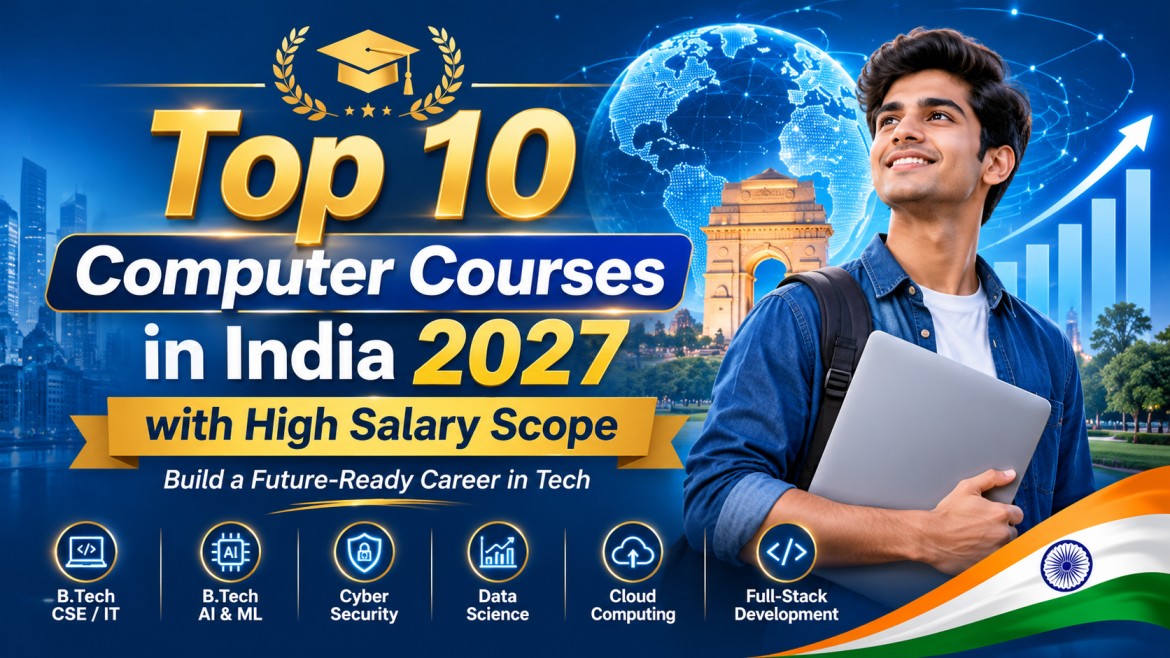
Top 10 Computer Courses in India 2027 with High Salary Scope
Every year around admission season, the same question comes up in every Indian household: “Beta, which computer course should we take?” And every year, the answer gets a little more complicated.
For 2027, the calculation has genuinely shifted. It is no longer just about “software engineer versus doctor.” The World Economic Forum’s Future of Jobs report shows that employer demand for AI and big-data skills is still rising through 2030, while routine clerical and data-entry roles are expected to shrink. That means the safest bet in 2027 is not just any computer course — it is a course tied to non-routine, judgement-heavy, system-building work that AI tools assist but cannot replace on their own.

Below are the 10 computer courses that currently show the strongest combination of realistic starting salaries, employer demand, and long-term relevance for Indian students and career-changers in 2027. I have avoided the headline-grabbing “₹50 LPA” figures that come from a handful of IIT seats and focused on numbers a normal student from a decent private or government college can actually expect.
Quick Comparison: Top 10 Computer Courses in India 2027
| Course | Typical Duration | Avg. Starting Salary (Fresher) | Best For |
|---|---|---|---|
| B.Tech CSE / IT | 4 years | ₹4–8 LPA (private/government); higher in top colleges | Students with PCM who want the broadest engineering base |
| B.Tech AI & ML | 4 years | ₹6–12 LPA | Strong maths students targeting AI engineer roles |
| B.Tech Cyber Security | 4 years | ₹4–8 LPA | Students who want a specialised, regulated security career |
| BCA (Computer Applications) | 3 years | ₹3–7 LPA | Students without PCM or those who want a faster, lower-fee degree |
| B.Sc Data Science | 3 years | ₹4–10 LPA | Analytics-focused students who prefer a science degree over engineering |
| AI & Machine Learning (certification) | 6–18 months | ₹8–20 LPA | Graduates and working professionals upskilling fast |
| Data Science & Analytics (certification) | 6–12 months | ₹6–14 LPA | Career-switchers moving into analytics |
| Cloud Computing / DevOps | 3–6 months | ₹6–15 LPA | IT professionals adding high-value infrastructure skills |
| Full-Stack Development | 6–12 months | ₹4–10 LPA | Coders who want the fastest route to a product-company job |
| Cybersecurity (certification) | 3–12 months | ₹5–12 LPA | Tech enthusiasts entering the security talent gap |
Salary ranges are realistic fresher figures for non-IIT private and government institutions. Top-tier college packages can be significantly higher, but they represent a small fraction of total seats.
1. B.Tech in Computer Science & Engineering (CSE)
Duration: 4 years | Fees (typical private): ₹4–7 lakh total | Starting salary: ₹4–8 LPA
B.Tech CSE remains the default “safe” computer degree in India, and for good reason. It gives you the widest base: programming, databases, operating systems, networking, and software engineering. From there, you can specialise into AI, security, cloud, or product engineering later.
What changed for 2027: Employers are no longer hiring CSE graduates just for “coding.” They want people who can build, test, and maintain the systems AI tools run on. That means projects, internships, and a GitHub profile matter more than ever.
Realistic salary reality: The famous ₹40 LPA offers come from IITs and a handful of top NITs. At a good private university, a realistic starting package for most CSE graduates sits between ₹4 and ₹8 LPA, with AI and data-science branches often at the higher end.
Who should take it: Class 12 PCM students who want maximum flexibility and are willing to put in four years for a formal engineering degree.
2. B.Tech in Artificial Intelligence & Machine Learning
Duration: 4 years | Fees (typical private): ₹6–8 lakh total | Starting salary: ₹6–12 LPA
AI/ML is the highest-paying degree-level computer course in the 2027 cycle. The demand is not speculative: the WEF data cited earlier shows employer demand for AI and big-data skills continuing to rise through 2030.
What you actually study: Statistics, Python, machine learning algorithms, deep learning, natural language processing, and MLOps (deploying models in production).
The catch: This course is maths-heavy. If you struggled with calculus and probability in school, the first two years will be rough. But for students who enjoy maths, the salary premium is real.
Who should take it: PCM students with strong maths who want to work as ML engineers, AI product associates, or data scientists.
3. B.Tech in Cyber Security
Duration: 4 years | Fees (typical private): ₹5–6 lakh total | Starting salary: ₹4–8 LPA
Every system that moves online creates another surface to defend. That is why security roles are not easily automated end-to-end — someone has to make judgement calls during an incident, and that someone needs training.
Career paths: Security analyst, ethical hacker, SOC (Security Operations Centre) analyst. Later, you can move into penetration testing, security architecture, or compliance.
Reality check: The degree gives you the foundation, but employers still value certifications like CompTIA Security+ or CEH alongside it. Plan to spend ₹15,000–₹40,000 on one good certification during your final year.
Who should take it: Students who like the idea of “breaking things to fix them” and are comfortable with networking and Linux fundamentals.
4. Bachelor of Computer Applications (BCA)
Duration: 3 years | Fees: ₹15,000 (distance/IGNOU) to ₹3 lakh (private) | Starting salary: ₹3–7 LPA
BCA is the most practical option for students who do not have PCM or who want to enter the workforce one year earlier than B.Tech graduates. It is also significantly cheaper: IGNOU’s BCA is one of the most affordable recognised computer degrees in India.
Where BCA graduates are getting hired in 2027: Software developer roles (₹3–6 lakh), data analyst roles (₹3–5 lakh), cybersecurity analyst roles (₹4–7 lakh), and cloud support associate roles (₹4–8 lakh) are all open to BCA graduates who have the right skills.
The honest limitation: Some core R&D and high-end AI roles still filter for B.Tech. If you want to close that gap, pair your BCA with a strong specialisation certification (AI/ML or cloud) and a solid project portfolio.
Who should take it: Commerce, arts, and PCB students; budget-conscious families; and anyone who wants a recognised degree without a four-year engineering commitment.
5. B.Sc in Data Science
Duration: 3 years | Fees: ₹2–4 lakh total (varies widely) | Starting salary: ₹4–10 LPA
B.Sc Data Science sits between BCA and B.Tech AI/ML. It is a science degree rather than an engineering degree, which means the focus is more on statistics, analytics, and applied data work than on building software systems from scratch.
Best for: Students who enjoy maths and statistics but do not want the full engineering load. It is also a good option for PCB students in universities where maths is not mandatory for admission.
Job titles: Data analyst, business intelligence analyst, junior data scientist, analytics consultant.
6. AI & Machine Learning Certification (Short-Term)
Duration: 6–18 months | Fees: ₹50,000–₹2.5 lakh (depending on provider) | Starting salary: ₹8–20 LPA for skilled graduates
This is the highest-salary non-degree path on the list — but only for people who already have a degree (any degree) and can demonstrate real model-building skills. AI-skilled freshers are commanding ₹8–22 lakh annually in some hiring reports, compared with ₹6–12 lakh for similarly experienced candidates without AI skills.
What separates the ₹8 LPA outcome from the ₹20 LPA outcome: A deployed project. Not a certificate. Employers in 2027 are sceptical of certificate-only candidates. A capstone project where you built, trained, and deployed a model — and can explain the trade-offs — is what converts interviews into offers.
Who should take it: Graduates from any stream with basic programming knowledge, and working professionals looking to pivot into AI roles.
7. Data Science & Analytics Certification
Duration: 6–12 months | Fees: ₹40,000–₹1.5 lakh | Starting salary: ₹6–14 LPA
Data Science has topped “in-demand” lists for five straight years, and 2027 is no exception. The tools are standard: Python, Pandas, SQL, Tableau or Power BI, plus basic statistics.
Where the jobs are: TCS, Infosys, Flipkart, and a long tail of startups actively hire data professionals. The entry-level title is usually “Data Analyst” rather than “Data Scientist” — the “Scientist” title typically requires 2–3 years of experience or a master’s degree.
Who should take it: Graduates and working professionals who want to move into analytics without committing to a full degree.
8. Cloud Computing (AWS / Azure / GCP) & DevOps
Duration: 3–6 months | Fees: ₹30,000–₹60,000 (many programs offer EMI) | Starting salary: ₹6–15 LPA
Cloud and DevOps pay better at entry level than almost any other technical skill in India — but this is also the field where certifications mislead the most. Employers now test Linux troubleshooting live, Terraform state management, Kubernetes debugging, and cost estimation. A certificate alone will not clear the interview.
What actually works: Build something, break it, fix it, and document the decisions. A personal deployed project with architecture decision records converts better in senior interviews than any exam result.
Who should take it: IT professionals with some Linux or networking background; career-changers willing to put in 3–6 months of hands-on lab work.
9. Full-Stack Development Bootcamp
Duration: 6–12 months | Fees: ₹30,000–₹1.2 lakh | Starting salary: ₹4–10 LPA
Full-stack development (front-end + back-end + database) remains the fastest route to a product-company job for people who can code. It is skill-first: a strong portfolio can outweigh a formal degree in many startups.
The 2027 twist: AI coding tools have made basic CRUD (create, read, update, delete) work faster, which means employers now expect full-stack developers to understand system design, APIs, and deployment earlier. A bootcamp that stops at “build a to-do app” is no longer enough.
Who should take it: Coders who want the shortest path to employment; BCA and B.Sc graduates who want to strengthen their practical profile.
10. Cybersecurity Certification (Short-Term)
Duration: 3–12 months | Fees: ₹25,000–₹1 lakh | Starting salary: ₹5–12 LPA
India faces a severe cybersecurity skill gap, and the demand is not limited to IT companies — banks, hospitals, e-commerce firms, and government agencies are all hiring.
Entry-level roles: SOC analyst, junior penetration tester, security operations associate.
What to study: Networking fundamentals (CompTIA Network+ level), Linux, web application security (OWASP Top 10), and at least one scripting language (Python or Bash). A CEH or CompTIA Security+ certification adds credibility, but hands-on labs (TryHackMe, Hack The Box) matter just as much in interviews.
Who should take it: Tech enthusiasts who are comfortable with self-study and lab work; IT support professionals looking to specialise.
How to Choose the Right Course for You (Without Regret)
1. Match the course to your stream, not to the salary table
B.Tech requires PCM. BCA and B.Sc IT are more flexible for commerce, arts, and PCB students. If you do not have PCM, forcing a B.Tech admission through management quota is usually a poor investment — BCA plus a strong specialisation is a more realistic path to the same job titles.
2. Separate degree fees from total cost
A B.Tech at a private university can cost ₹4–8 lakh in tuition alone. A BCA from IGNOU costs a fraction of that. Short-term certifications cost ₹30,000–₹1.5 lakh. Do not compare a ₹6 LPA salary from a ₹6 lakh degree with a ₹4 LPA salary from a ₹50,000 certification without calculating the payback period.
3. Look for projects, not just syllabus
Every brochure lists “Python” and “machine learning.” What separates a good program is whether it forces you to deploy something, break it, and fix it. Ask the admission counsellor: “What will I have built by the end of this course?” If the answer is vague, look elsewhere.
4. Check the placement reality, not the highest package
A college that advertises a ₹40 LPA highest package but has a ₹4 LPA median is telling you two different stories. Ask for the median salary and the percentage of students placed, not the highest offer.
5. Plan for one certification, not five
In cloud, security, and AI, one well-chosen certification plus a deployed project beats five certificates with no proof of work.
Frequently Asked Questions (FAQ)
Q1. Which computer course has the highest salary scope in India in 2027?
At the degree level, B.Tech AI & ML shows the highest realistic starting range (₹6–12 LPA for freshers at decent colleges). At the certification level, AI & Machine Learning programs report ranges of ₹8–20 LPA for skilled graduates. However, “highest salary” depends heavily on your college, projects, and interview performance — not the course name alone.
Q2. Can I get a high-salary job with a BCA instead of B.Tech?
Yes, but the path is narrower. BCA graduates are hired as software developers (₹3–6 lakh), data analysts (₹3–5 lakh), and cloud support associates (₹4–8 lakh). To reach the higher end, you need a specialisation certification (AI, cloud, or cybersecurity) and a strong project portfolio. Some core R&D roles still prefer B.Tech, but product companies and startups increasingly hire on skill.
Q3. Which short-term computer course gives the best salary in 2027?
Cloud Computing / DevOps and AI & ML certifications currently show the strongest entry-level salary ranges (₹6–15 LPA and ₹8–20 LPA respectively) for candidates who can demonstrate hands-on work. Full-stack development (₹4–10 LPA) is the fastest route to a job but has a lower ceiling at entry level.
Q4. Is B.Tech CSE still worth it in 2027, or should I take AI/ML directly?
B.Tech CSE is still worth it because it gives you the broadest base and keeps all specialisations open. AI/ML is a specialisation, not a replacement — many CSE graduates later move into AI roles through electives and projects. If you are certain about AI and have strong maths, a dedicated AI/ML degree can give you a head start. If you are unsure, CSE is the safer choice.
Q5. What is the fees range for computer courses in India in 2027?
Degree fees range from ₹15,000 for distance BCA programs to ₹7–8 lakh for private B.Tech AI/ML programs. Short-term certifications typically cost ₹30,000–₹1.5 lakh, with cloud and AI programs at the higher end. Government college fees are significantly lower than private college fees.
Q6. Do I need to know coding before joining a computer course?
For degree programs, no — B.Tech, BCA, and B.Sc start from the basics. For short-term certifications, yes — most AI, data science, and full-stack bootcamps assume basic programming knowledge (loops, functions, variables). If you are starting from zero, spend 4–6 weeks on Python fundamentals before joining a paid program.
Q7. Which computer course is best for commerce students in 2027?
BCA is the most direct route for commerce students into software roles, and BBA with IT specialisation or B.Com with Computer Applications are also viable. For commerce students interested in analytics, a Data Science certification after graduation can open business-intelligence roles, where domain knowledge of finance or accounting is an advantage.
Q8. Will AI replace computer science jobs by 2027?
AI is changing computer science jobs, not eliminating them. The WEF data shows demand rising for AI, big data, and non-routine technical roles, while routine data-entry and clerical work declines. The safest strategy is to build skills in system design, security, AI engineering, and cloud infrastructure — areas where human judgement and architecture decisions remain essential.
There is no single “best” computer course in India for 2027. There is only the course that matches your stream, your budget, and your willingness to build real projects. The salary tables are a starting point, not a guarantee. The students who will earn at the top of these ranges are not the ones who picked the most fashionable course name — they are the ones who graduated with something deployed, documented, and defensible in an interview.
If you are choosing between two courses, pick the one that forces you to build more. That is the skill 2027 employers are actually paying for.
If you want to Open Computer Center: Apply Now, ADCA Course
